Showing posts with label Comicbooks. Show all posts

Wednesday, February 9, 2011

Henry & Glenn Forever gets weird(er)


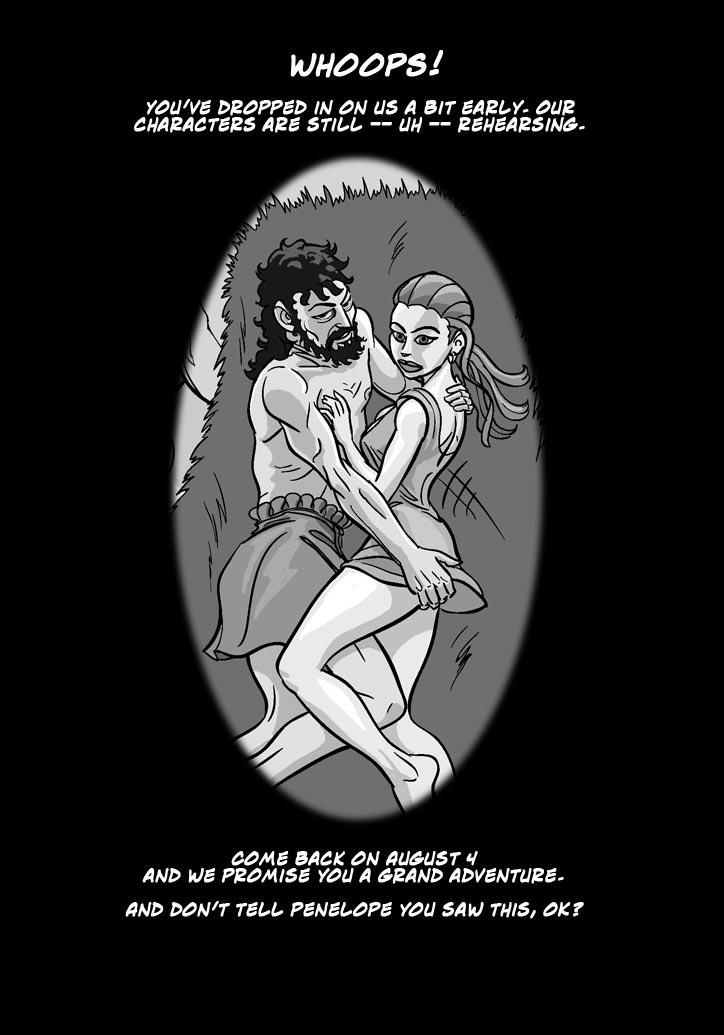
If you're not familiar with the Igloo Tornado's Henry & Glenn Forever book, you're missing out on some cosmic-level weirdness. The idea began as a collection of cartoons from various artists depicting punk/metal icons Glenn Danzig and Henry Rollins as a happily married gay couple living in suburbia. Since then it's ... well, you see the artwork above, right? You can find more at the H&G Facebook page. Buy the book HERE. I SAID BUY IT!

Since the initial book was published, the concept has exploded into public art exhibits, music and other forms of expression.  Every time it appears to have run its course, someone else steps up with an idea that extends it a few more minutes. H&G has been a blast so far but I have to wonder where it will end. I suspect the words "murder" and "Danzig" will be involved somehow, though.

Tuesday, September 14, 2010

The People vs. Superman

The New York Times has a feature about a Yale exhibit showcasing superheroes and courtrooms. My first thought was that an entire exhibit could be built around Daredevil, alone, but guess what? Neither Matt Murdock nor the Man Without Fear rate a mention. Harvey Dent's name doesn't appear in the story, either. Pfft.

Don't let that get you down, though. While the author's own knowledge of comics appears to be incredibly limited, he doesn't waste any time pointing out that comic creators don't seem to know much about the law. Apparently research is necessary only if you draw funny books.
From the story:
"For starters, the little girl in that Superman cover would have been seated in the witness chair, if in fact taking sworn testimony from a minor in open court was allowed in the Metropolis jurisdiction, and Superman would have been elsewhere in the courtroom. But you probably won’t mind that the creators sacrificed a bit of reality for drama, which is also why, you know, the main character can fly."

Tuesday, May 25, 2010

The Batman Chronicles: Vol. 1


The Batman Chronicles seems so obvious an idea that I’m amazed DC didn't think of it earlier: reprint every Batman story in order of appearance, merging Detective Comics, World’s Finest and the solo Batman title into a single series of trade paperbacks.

The first volume collects a brief but special time in Batman’s history: his days as a dangerous (and clearly insane) vigilante. There are few superhero fetishes present in the stories during Batman’s real “Year One.” He keeps his bat costume in a steamer trunk, drives around is a red sports car and kills without a second thought (or even a first thought, for that.)

This is the Batman that inspired Frank Miller’s tales, the violent vigilante more interested in stomping criminals than stomping crime. When the villains of these early tales land in jail it’s usually by mistake. This version of Batman would just as soon break your neck than turn you over to the cops.


The artwork in this first volume carries a lot of weight, with each panel having to convey more than modern readers might be used to. In The Dirigible of Doom, a blimp lays waste to the as-yet unnamed Gotham City, toppling skyscrapers with some sort of energy cannon. It’s one of the most powerful images of these early stories and Bruce Wayne is even shown — for all of a single panel — helping to pull survivors out of the wreckage. These old stories cover a lot of ground in just a little space, so a little more care and attention is needed to fully savor them.

The Dirigible of Doom also illustrates some of the problems with these old stories. As impressive as the threat is, the badguys are sometimes a little goofy. The man revealed to be behind the killer blimp is some dumpy guy with a “Napoleon Complex” (having him dress as Napoleon is an incredibly literal — if stupid — way of interpreting that particular mental disorder.)

These early stories also tend to rush their endings, as though Bill Finger or Bob Kane realized late in the day that they’re running out of room. It’s common to see a story rocket along, only to tie up as many threads as quickly as possible in the final page.

Some of the earlier villains still interest me, though. Dr. Death, the Mad Monk and Hugo Strange are as creepy as ever, though few writers have ever been able to bring these characters part-and-parcel into modern settings. These characters would be right at home in Sandman Mystery Theater and are strangely perverse, sadistic figures.

Batman is also shown frequently carrying a gun in these Pre-Robin stories, though he rarely uses it. Some of this “gun art” looks to be cribbed from art in The Shadow pulps. Given Bob Kane’s contributions to history’s “swipe files” this seems pretty likely. In fact, there is little to no difference between Bruce Wayne and Lamont Cranston in Batman’s early days. His villains eventually set the two characters apart.

The first volume also features the brilliant first appearances of Robin and The Joker, as well as Catwoman’s barely recognizable debut. Those have been written about at length elsewhere so I won’t drone on about those famous stories too much. They still hold up tremendously well, though. And it’s impressive how much The Joker’s first two appearances contributed to his interpretation in The Dark Knight film.

Thursday, May 20, 2010

Henry & Glenn Forever


You know ... I'm actually kind of speechless. But you know who won't be? Glenn Danzig. Dude has never met a lawsuit he didn't like. Here's how the comic is described by the creators, Igloo Tornado:

"Henry and Glenn Forever is the ridiculous idea born out of a night of too many beers shared by a group of artists who sometimes call themselves Igloo Tornado. On that night Gin Stevens said "There should be a Tom of Finland book, but with Henry and Glenn..." and Tom Neely and Scot Nobles replied: "Yes! And we're going to do it!" This bold idea (or is it a bad idea?) became a small zine that grew into a notorious legend that has now become a nice little book published by Cantankerous Titles!"

I stumbled over this at Time Out New York, which not only as a song from Danzig's new album Deth Red Sabaoth streaming for your pleasure, but linked to a separate LA Weekly  story about Henry and Glenn Forever. This little nugget was buried in the story:

"Allegedly, when Henry Rollins was shown an earlier version of the minicomic, his reaction was to ask if Glenn had seen it yet. Rollins thought Danzig would have been less than amused."

Gee, do you think? James O'Barr once told me Danzig sued him because he thought he based the hero of The Crow on him.

Blackest Night: Excessive and Inconsequential

By the end, I’d learned to hate Blackest Night.

I went into this series with only the most fundamental of expectations. Even though I wasn’t doing backflips over the idea of reviving Hal Jordan, the new Green Lantern series has been a pretty good read (though it’s been prone to ponderous moments that ask for too much of its character.) All I really expected from it was something along the lines of Secret Invasion — a fun story that branched off from its parent title. It didn’t need to impact every title in the company’s publishing schedule or “change things forever.” Truth be told, I’d rather that not happen.

But Blackest Night has no “story,” even by the loosest definition of the word. Instead, Blackest Night is a hodgepodge of shocking moments, bullshit metaphysics and macho posturing. The violence in the series was excessive and ultimately inconsequential— which might be the best way to describe Blackest Night, as well.

By the time the series was over I had no idea what I’d read. Not only did it make no sense, it diluted the Green Lantern concept to the point of irrelevance. This is the reason Hal Jordan was revived? So he could join some rainbow coalition of peacemakers who are so one-dimensional that they’re all defined by a single emotion and color scheme? Somebody has grossly misinterpreted what it is people like about Green Lantern, and I’m pretty sure it’s not me.

This isn’t run-of-the-mill fanboy petulance (at least I hope it’s not.) I’m not all that fond of companywide crossovers because they usually spend a lot of time spinning their wheels but rarely ever go anywhere memorable. If you look back at the best books to spring out of these “event” stories, you’ll find only the thinnest relationship between them. Did Starman really need Zero Hour to justify its existence? Did JLI need Legends? Do any of the new Brightest Day spinoffs really need Blackest Night?

While the primary reason for event books to exist is money, DC too often uses these stories to justify and "sell" their editorial decisions. It’s not enough for editors to decide that Batman needs to be less of a dick … they’ve got to find a multi-part storyline that justifies this change in character. It’s curious that these kinds of changes need never be justified when an A-list creator takes over a title. Where was the Great Event that explained the breach in style between William Messner-Loebs and John Byrne’s takes on Wonder Woman, which changed radically between issues without so much as a wink to readers?

Blackest Night appeared to be a mea culpa, of sorts. It was an acknowledgement that superhero comics had become kill crazy, and that it was time to stop trotting out murder as the driving factor in every story. Not only was it old hat, but these “deaths” never seemed to be permanent, anyway. It was the dramatic equivalent of watching a tightrope walker lower his platform to about 6 feet off the ground, but still demand a safety net. No matter how bad things got you knew they’d never get too bad.

DC’s solution to the “Death Problem?” Revive all the dead DC folks as zombies and have them kill most of the surviving characters in the company catalog. There seems to be a very clear statement about comicbook editorial policy, death and event titles buried somewhere in Blackest Night, but I’ll be damned if I can figure out what it is.

It didn’t help that Geoff Johns telegraphed the ending to the book in the first few issues. So many people died in the opening chapters that it seemed impossible that a deus ex machina ending was anything less than inevitable. Something was bound to happen that returned some kind of status quo to DC and revive most — if not all — of these dead characters.

Which is exactly what happened ... and in the most confusing way possible. I expect I’ll return to Blackest Night a few times in coming years to see if my feelings on the book will change, because I really don’t want to hate it (I still own a full-run of Millennium, after all.) But I think I might be done with superhero event stories in the future.

Tuesday, May 18, 2010

Ugh ... criticism

The older I get, the fewer comic books I read.

I probably read more today than ever before, but I find myself buying fewer and fewer of the traditional "pamphlet" magazines. On the best day they're expensive and uneven, with most story arcs stretching between four and six months. That's a long time to wait to read a complete story, especially considering how quickly you can read a comic.

Consequently, I buy a lot of trades and give a lot of monthly titles a miss. And if for some reason I don't buy the TPB, then I guess I didn't really want it that badly to begin with.

This week I made the decision to deliberately skip monthly books that are sure to get s TPB release, with a few exceptions. I've been reading Daredevil on a monthly basis for so long that I'm a little hesitant — even superstitious – about breaking that streak. The same goes for Batman, Detective Comics and New Avengers.

As for the rest ... well, there are no certainties in life when you're name is Aquaman or Green Arrow. It's just common sense not to expect their stories to be collected in TPB (but Green Arrow's popularity on the secondary market has been a pleasant surprise.) And look how long it's taken DC to collect Sandman Mystery Theater ... I never thought that would happen.
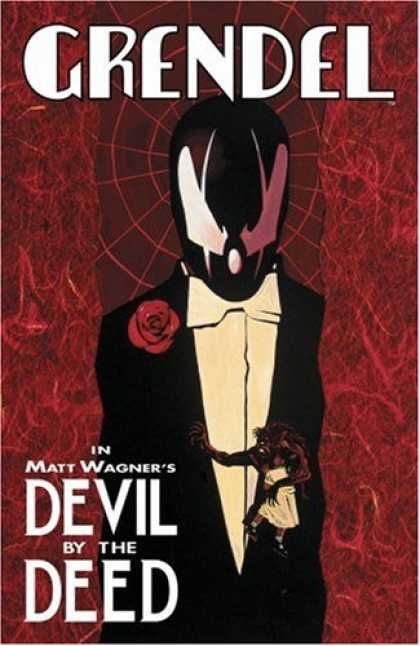


Which leaves me with a lot of graphic novels to read; collected, complete and finite tales that live outside the endless boundaries of the monthly format. I've been getting caught up on some books — some old, others not — and thought I'd write about them here. I've already mentioned Johnny Cash: I See a Darkness (which you can read here) and plan to review Odysseus the Rebel, Godland Vol. 1 and Grendel: Devil by the Deed during the next week or so. I also want to say a little about Melissa Auf Der Maur's Out of Our Minds album, too.

So, expect a fair amount of criticism at this site in the near future. And try not to hold it against me ... because I'm always right, even when I'm wrong.

Thursday, May 13, 2010

Johnny Cash: I See A Darkness


In Johnny Cash: I See A Darkness, artist Reinhard Kleist did something rarely seen in biographies: he reigned in the bullshit and let the facts speak for themselves. Mostly.

The graphic novel recounts Cash's life in both broad strokes and angular symbolism. Cash's "stories" — his songs — make literal appearances in the book, adapted by Kleist at random intervals and usually without warning. The opening chapter recounts the back story of the song "Folsom Prison Blues," but you have to pay careful attention to the tale's details to even recognize what it is you're reading. It was fascinating to see these songs translated to a medium without sound and Kleist sufficiently shows how near and far the two mediums really are from each other.

But these songs are just a small part of the overall tale and are used sparingly to illustrate Cash's sometimes whimsical nature and darker impulses. Cash is shown discussing this gulf in her personality with such folks as Bob Dylan, Rick Rubin and his own family, none of whom really seem to understand him. It's likely the readers of this book will feel a closer kinship to its protagonist than the rest of the story's cast.

To Kleist's credit he steers clear of the common pitfall of dramatic biographies by not tying the subject's life into a narrative that never really existed. The thread that ties the story together is Cash's appearance at Folsom Prison and the impact it had on the life of one inmate. What you get from this book probably depends on how you choose to interpret this element of the story because, by its end, even Cash is baffled by its significance.

But the overall randomness of the story is as apt a metaphor for life as I've ever seen. I See a Darkness is a lengthy collection of random events without clear cause or effect. Kleist seeks depth without depending on superficial or melodramatic cliches and he finds it more often than not.

Thursday, March 25, 2010

Rom # 1 — “Arrival”

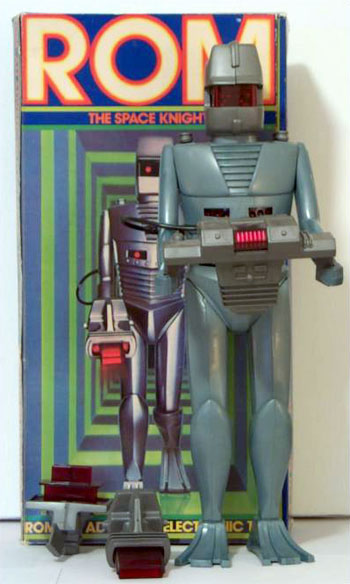
There’s not much about Rom that’s not a product of its time. On a purely tactile level it’s a relic of the days when comics were still published on newsprint and local businesses could still afford to advertise in a nationally distributed comic book. From the cover design (structured to maximize visibility on news racks) to the limited color palettes of the interior art, comics today no longer look, feel or even smell the way they used to.


Rom's story, too, comes from the days when toy companies were anxious to bypass federal laws affecting children’s television (laws that were later changed, opening the floodgates for toyetic shows as G.I. Joe, Transformers, etc.)
Comic books had no such regulations so nothing stood between Parker Bros. and Marvel from conspiring to bring extended ads for the Rom toy to print. 
As a toy, Rom was a thin premise by anyone’s measure. He had no supporting cast, no villains and no real personality. If the 12” Star Wars line of toys couldn’t find success on the market in the late 1970s, then what kind of chance did the oversized Rom toy stand?

The toy wasn’t in production very long, but the comic was a different story. Launched in late 1979, Rom: Spaceknight ran for 75 issues and was in print for seven years. The license for the toy probably made Parker Bros. more money than the actual toy ever did.
Back in 1979, though, writer Bill Mantlo and artist Sal Buscema were left with a problem of endowing a lifeless plastic toy with some kind of character and direction. Mantlo lifted from a variety of sources, from It Came from Outer Space to Marvel’s own Silver Surfer. While it falls into the traditional Stan Lee mold of heroic outsider, there’s a sense of paranoia to this story not seen in other Marvel titles. In many ways the shape-changing villains found in the Dire Wraiths lay the groundwork for the recent Secret Invasion storyline, which grafted the Skrulls onto the Dire Wraiths “conspiracy” subplot of Rom. (You might also argue that the give and take between Rom and the Fantastic Four extends to stealing the idea of the Dire Wraiths from the Skrulls.)

The first issues covers a lot of ground in just a few pages. An alien from the planet Galador, Rom sacrifices his humanity to bond with an almost magical suit of space armor in order to protect his people from the menace of the Dire Wraiths. Rom pursues the shape changing baddies to Earth and, thanks to his rotten communication skills, finds himself fighting the wraiths, the military and pretty much everyone else he comes into contact with.
In his arsenal is a gun that zaps his enemies into a Phantom Zone-like dimension, as well as a lamp that reveals who is human and who is not. And that’s pretty much all he thinks he needs, I guess. He doesn’t have a clue about how Earth operates, has done no research and has no strategy.
If it sounds like a lame plan, you’re right. What’s interesting is that, amid all the ideas stolen wholesale from Lee and Kirby, there’s a strange effort to cast Rom as a character with an infantile psychology. On the surface it’s just another “stranger in a strange land” story that Marvel so loves, but Rom clearly has no understanding that his actions have consequences. He leaps into one situation after another without ever realizing that something bad might happen. He’s a child who has to learn (and re-learn) that the burner on the stove is hot. If you can’t tell, I’m trying really, really hard not to call him a moron.
Both the story and art are wildly uneven. The art is the easiest element of a comic book to evaluate because problems with line work, layouts, lettering and the rest can be easily spotted within a matter of seconds. Holding the pencil at the beginning of Rom is Sal Buscema, an artist with a dubious track record.
I don’t think Buscema is a terrible artist. He’s a solid, if unspectacular, creator who was usually good enough for whatever book he was assigned. The first issue of Rom is a typical example of Buscema’s linework and layouts. It ranges from the genuinely great opening page (which was recycled by Marvel as a house ad for the series) to the embarrassing space opera designs seen in the flashback sequence. In between the art is serviceable.

I’m not sure that Buscema gave much thought to Mantlo’s script. If you ignore the art, you’ll find a story that has more in common with 1950s sci-fi paranoia thrillers like It Came from Outer Space, Invasion of the Body Snatchers and Them! While it’s not perfect, the Ray Bradbury influences of the story certainly make the concepts stand out from the rest of the books Marvel was publishing at the time. The downside is that everything Mantlo and Buscema knew about small town life came from watching The Andy Griffith Show, so the West Virginia “locals” seen in this issue are the broadest kinds of stereotypes.

Superficially, Rom is a product of its time, which isn’t a bad thing. Calling something “dated” is a polite way of saying it’s irrelevant, but that’s not the same as being uninteresting. Whatever Rom's flaws,  the book was far from uninteresting.


Monday, March 1, 2010

A Muppet Wicker Man


This is pretty awesome: a B&W online comic that puts the cast of The Muppet Show into the classic horror film The Wicker Man. I'm speechless. And not that kind of "speechless" where someone says "I'm speechless" and then proceeds to write another 300 words.

Word of warning: the embedded comic includes scenes of Miss Piggy in the buff.

Click the "comic" below to read it fullscreen.

Saturday, February 27, 2010

The Spice Must Flow!

Above is a prop I recently purchased from Reel Art in Florida: a resin model of the crysknife from the 1984 movie Dune. I'd made a mistake on my shipping address and gave them a call to make sure it was mailed to the right place. One of the owners asked me what I planned to do with he knife and assumed I'd be using it for cosplay. I told him I planned to display in in a shadowbox, but should have told him that I was going to settle a score with Sting for those last 10 solo albums he released. Boy, did they suck.

I'm an unabashed Dune fan. I love the original Frank Herbert books, as well as David Lynch's film. It's a lush, smart movie that doesn't get enough credit and holds up incredibly well bracketed between The Elephant Man and Blue Velvet.
On the other hand, if you were expecting Star Wars then you were probably a little baffled. Dino DeLaurentis certainly marketed the film as though he believed Dune was another summer action movie for kids, stopping just short of including sandworms in McDonald's Happy Meals (although a cinnamon-flavored "Spice Shake" would have been awesome.)
Still, a lot of the Dune merchandise was grossly inappropriate. I don't know which is more baffling: coloring books based on Frank Herbert's heady, neofacist religious parable ... or that someone once tried to sell toys based on characters in a David Lynch movie.

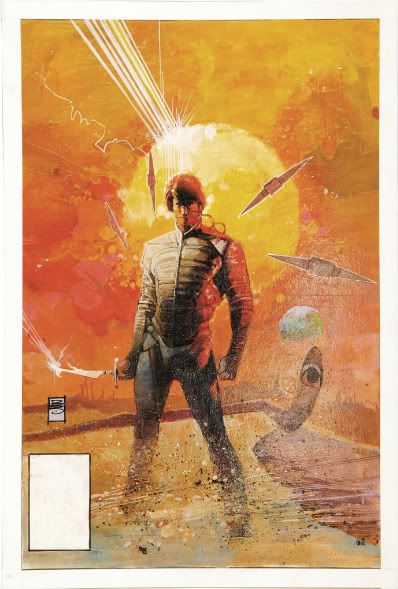
Among the products aimed at the youth market was the Marvel Comics adaptation, which was (and still is) pretty damn great. Illustrated by Bill Sienkiewicz, it's the closest we're ever going to get to a "Classics Illustrated" version of Dune. This comic is a terrific piece of art in its own right.

DOWNLOAD the comic here.

(Note: The art above is the unadulterated cover for a pocketbook edition of the comic, which collected the entire miniseries.)


Most certainly NOT aimed at the youth market was an audio interview recorded by Waldenbooks with Frank Herbert and David Lynch. Herbert has passed away since this was recorded in 1983, while Lynch has pretty much stopped trying to explain his movies in any conventional manner. He's also stopped talking about Dune in any way, shape or form ... so it's refreshing to hear him so enthusiastic about the project and talking about the scripts for the planned sequels.
Below is a download link for the six-part Herbert/Lynch interview. It also includes a seventh MP3 file of an unrelated interview with Herbert.

DOWNLOAD: Dune: A Recorded Interview

Friday, February 26, 2010

The Teen Titans return (again)

Wow.
Not long before the first issue hit the stands, DC let creators Marv Wolfman and George Perez take their new Teen Titans idea for a test drive. A short, 16-page story was inserted into the pages of the Superman team-up book DC Comics Presents to let a wider audience get a look at the series. It was not only a savvy business idea, but a solid story, as well.
Wolfman forgoes the usual introductions by throwing a very confused Robin into a future where a thriving new group of Teen Titans — which had been disbanded for months in his reality —
battle an extra-dimensional organism. The story tricks both Robin and the reader into off-the-cuff introductions and character exposition without ever bogging down the story (which is something a 16-page sampler couldn't afford to do.)
The tale has an interesting structure. Robin begins to lose his equilibrium while dealing with a mundane terrorist threat (so mundane that, like the jewel heist in Reservoir Dogs, it is never shown in panel). He loses consciousness several times, awakening in a false future where he and a new group of Teen Titans fight to send an alien blob back to its dimension. The story collapses inward as Robin's "dream" threatens to pull him into a third reality of an alien dimension before he's hastily pulled back to his own reality. By this point, though, neither the character nor the reader know what to think about the events of the story.
It’s revealed that Raven, the mysterious new “witch” on the team, has manipulated Robin into confronting his own doubts about the Titans in anticipation of a more aggressive effort to draw her players to the battlefield in the first issue of the on-going series. The fact that Robin’s vision of the future comes to pass — though this particular conflict never does — is only icing on the cake.
Wolfman and Perez leap the usual hurdles of introduction stories with ease and set the stage for a much more elaborate “cute meet” in the first issue of the on-going series. It's not every team that gets two origin stories.

Tuesday, February 23, 2010

Marvel Premiere #35 — 3-D Man

I like the 3-D Man.
There, I said it.
This affection for the character doesn't have any great depth or mystery behind it. The first time I ever saw the character was in an issue of
The Official Handbook of the Marvel Universe and I was struck by his costume. I was one of those odd kids of the '70s who actually got to see some classic 3-D movies in the theater and my discovery of 3-D Man arrived right at the cusp of the 3-D revival of the 1980s. (This revival didn't last very long, thanks to the cinematic abominations like Jaws 3-D, Amityville 3-D, Metalstorm, etc.)
I'll be damned if 3-D man wasn't a little hard to find, though. His appearances were limited to a handful of Marvel promo books which had very little demand among later fans. The books were worthless, so they should have been inexpensive ... but there was no profit in them so retailers tended not to stock them.
It's an odd book from top to bottom, something typical of Bronze Age comics. Meant as a throwback to a time when Marvel had no superheroes, the character begins as a test pilot in the 1950s. After a run in with the Skrulls (chronologically predating their first appearance in Fantastic Four) he acquires the power to ... well, I'm not exactly sure
what his powers were. He apparently has three times the strength, speed and stamina of a normal man but, unlike normal men, spends 21 hours of the day trapped inside the lenses of a pair of kooky glasses.
During a three-part story arc (Marvel Premiere 35-37) 3-D Man grapples with the evils of rock and roll, aliens, brainwashing and the explanation as to what might really have been behind the Bermuda Triangle (the Skrulls.)
It's all a little hard to swallow as nostalgia, though, because the book takes place just a few years before the first issue of Fantastic Four hit the stands ... and Ben Grimm is even referenced directly in the story as a notable test pilot. For some reason, though, 3-D Man is a character stuck in an editorial conceit of a fictional 1958, while the rest of the Marvel Universe was allowed to move on. I have no idea how this issue was addressed in his later appearance in The Incredible Hulk, and the character was later re-vamped as the deadly dull Triathlon in The Avengers.

Sunday, February 21, 2010

Vertigo gets off to an early start

DC Comic's "Vertigo" imprint didn't launch until 1993, but the seeds for the line had been in place since the early 1970s. DC had experimented with more mature titles (i.e., "not superheroes") a few times, with such books as Swamp Thing, The Shadow, Jonah Hex and their assorted mystery/horror anthologies. For a lot of reasons (such as the the national paper shortage, changes in editorial staff, etc.) the company had a hard time keeping any new book in print for more than a dozen issues, so many of their best books were also their most brief.
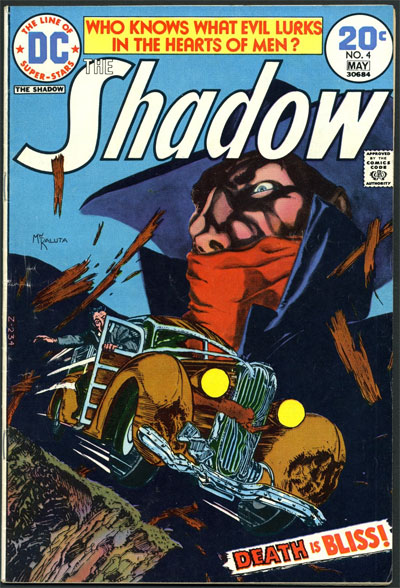
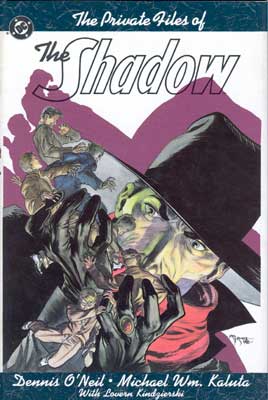
One of the best comics the company published in the 1070s was the Denny O'Neil/Mike Kaluta interpretation of The Shadow (it also featured some occasionally uncredited assistance from Jeff Jones and Bernie Wrightson.) It was a no-nonsense interpretation of the William Gibson pulps, with The Shadow portrayed more like an underworld boogeyman than a costumed adventurer. Kaluta left the book after a few issues, with the remainder completed by the likes of Frank Robbins and the much-underrated E.R. Cruz. The series even featured the first meeting of The Shadow and The Avenger, something that pulp fanboys had wondered about for decades. They'd meet again in the late 1980s, during the controversial — and hilarious — run on The Shadow by Andy Helfler and Kyle Baker (anther prototype series for Vertigo.)
After a dozen issues, though, DC pulled the plug. O'Neil said he was never offered a reason for the book's cancellation and had every reason to believe it had sold well (at least well enough to continue publication.) The O'Neil/Kaluta stories were collected in The Private Files of The Shadow, a hardback that has been out of print for many years (and will likley remain so, seeing how the comic rights to The Shadow are about as popular as Chris Brown right now.)

Saturday, February 20, 2010

Godzilla is a Four-Letter Word


Here's a story that kinda creeps me out.
When I was a kid (maybe five years old) my neighbor had a copy of Godzilla that had the Avengers in it. I was floored seeing the likes of Thor and Iron-Man on the same pages as Godzilla. But my neighbor, who was a few years older than me, wouldn't let me read it.
His reason? It was full of too many "bad words." He'd open the pages at random and point to some word in a balloon and tell me it was a "cuss word" and that I shouldn't say it.
Part of me wants to think that he simply didn't want to share his comic, but if it was a power play he'd have got a kick out of taunting me (which he didn't.) If he really wanted to embarrass me, he would have done the opposite: trick me into thinking a dirty word was, in fact, harmless (which would have provided much more entertainment.)
As it stands, I don't know what his goal was. It still weirds me out. I still haven't got around to reading this issue, though I did meet the artist on the book (Herb Trimpe) last year. No profanity was involved in the exchange.

Friday, February 19, 2010

Eduardo Barreto 'gravely ill'

Here's a depressing headline from The Washington Post:

BREAKING: 'Judge Parker' artist Eduardo Barreto is 'gravely ill'; new artist sought

Excerpt:
Beginning next week, readers will notice a sig
nificantly different look to the comic strip "Judge Parker." That is because Eduardo Barreto, the feature's artist since 2006, is gravely ill.

"Eduardo is not coming back," Woody Wilson, the longtime writer of "Judge Parker" and "Rex Morgan M.D." tells Comic Riffs. "He's gravely ill. He has told us he will not be able to [draw the comic for] the foreseeable future."

The first time I remember seeing Barreto's work was on The New Titans, not long after George Perez left the re-launched direct sales title. And I hated him. They couldn't have found an artist more different from Perez — who'd worked on The New Teen Titans for 7 or 8 years straight — had they done so on purpose.

But here's the strange thing: by the time Barreto left the book, I was sorry to see him go. With enough time he won me over and I've been a fan ever since. (I had the same response/resolution when Tom Grummett took over the pencils for Titans.)

While I'm still not sure Barreto was the appropriate artist for a book like the Teen Titans/New Titans, he found a comfortable home in The Shadow Strikes, DC's "conventional" take on the pulp hero. He and Gerard Jones re-wrote many of the classic pulp novels and streamlined them into a comicbook narrative. Barreto's style is pure pulp fiction. It's no surprise to me that he's found so much work in the subsequent years drawing crime-related comics.

Here's hoping he makes a full recovery.


Batman #169: "Partners in Plunder"

Here's a little side trip to the Silver Age, an issue of Batman that has him matching wits with himself.
This is an interesting little story from an era notoriously light in substance. The line of Batman books had been recently invigorated with a new editorial direction (called "The New Look.") For the first time in many years, Batman and Robin were allowed to fight crime instead of aliens and robots.
What's interesting is that, during these years, the Dynamic Duo fought plain-clothed gangsters more often than the deformed/costumed criminals they are best known for. During the first year the Joker, Penguin and the Riddler all made an appearance in either Batman or Detective, but the creative team seemed more interested in inventing new villains.
Batman #169 is the first appearance of the Penguin in the "New Look" era, but he's changed little from his early days. He's still obsessed with umbrellas and how they can be used in crime, and has no overt interest in hurting anyone.
His plan in this issued, titled "Partners in Plunder," is surprisingly clever, though. He begins a wave of chaos in Gotham, flooding streets and stores with wacky umbrellas that cause a lot of confusion — but there doesn't appear to be method to the madness. Batman is sure the Penguin is responsible, but can neither prove it nor figure out the point to it all.
The reason is simple: the is no point. The Penguin's plan is to create a criminal "Rorshach blot" layered in possible clues and symbols that have no meaning. He's convinced — rightfully so — that Batman will infer what he will from the "clues" and find a way to keep the Penguin from reaching the alleged goal. Little does he know that the Penguin planted listening devices in a few of the umbrellas confiscated by Batman. He's been listening in on the Dynamic Duo's speculations and likes what he hears. He also know how Batman plans to stop him, which gives him the edge.
Even though he successfully pulls off the scam Batman has unwittingly planned for him (the theft of a jeweled meteorite) he fails to get away. During a chase using rocket umbrellas, Robin's lighter weight allows him to overtake the Penguin and throw a lasso around him. It's a victory for the Dynamic Duo, but not one they necessarily earned.

Thursday, February 18, 2010

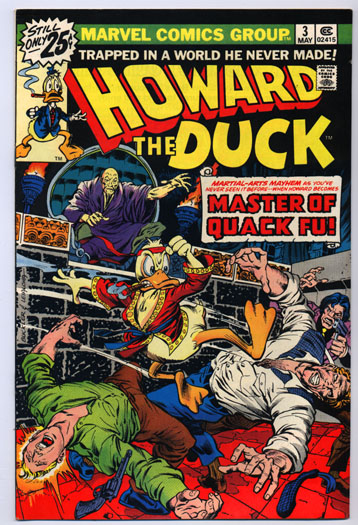
The Master of Quack Fu

I love me some Howard the Duck, but the book always worked best when it avoided explicit superhero parodies.
The weakest issues in the series were parodies of other Marvel titles. Sure, “Iron Duck” and the “Master of Quack Fu” made for some great cover art, but the stories were tepid (Howard as “Son of Satan” is the exception.)
The third issue is intended as a lampoon of the kung fu craze of the mid 1970s. The problem is that writer Steve Gerber didn't really know what he thinks about the fad. Howard, of course, hates it, but Gerber can’t eloquently explain why and the book frequently contradicts itself.
The story begins with Howard and Beverly leaving a kung fu movie. Howard is clearly disgusted by the violence in the film, calling it “training for the local troops.” He also takes issue with Hollywood exploiting as “ancient tradition” for its own end as he stands on the street shouting at people. All he needs is a box to stand on with the word “soap” written on it.
Anyway, the kung fu craze gets out of control when, at a local diner, Howard and Bev see a character named "Count Macho" (based on Count Dante, who ran numerous ads in comics in the 1970s) kill an overzealous karate fan.
Early in the issue, Howard proclaims that people who enjoy violence "don't have the mental equipment to be sure they exist." So what does he do when Count Macho kidnaps Bev? He takes a crash course in kung fu so that he can fight back. Like all good liberals (and conservatives, for that) Howard's real concern isn't his own ability to process reality ... it's everyone else's. He thinks he lives in a world of idiots, which is probably true. He simply can't recognize that he's an idiot, too.
I'm not really sure what Gerber's message was. It begins as a slam against kung fu movies, but the story would have felt at home in a Shaw Brothers picture. Howard abhors violence, but turns to it the first chance he gets. Because the story has no intellectual center to argue from the issue feels like nothing more than propaganda.
"The Master of Quack Fu" features guest art by John Buscema. Frank Brunner quit after drawing the first two issues when Marvel passed on a requested pay raise he believed he deserved for working on one of the company's best-selling titles (right behind Marvel's Star Wars comic at the time.)
It was their loss ... Brunner is a fantastic artist. But Gene Colan was waiting in the wings — no pun intended — and became "the" Howard artist for the rest of the title's publication.

Wednesday, February 17, 2010

2010 Glyph Comics Awards nominees


I don't spend a lot of time worrying about awards, whether they're mine or anyone else's. But I thought I'd pass along a few names from the recently announced Glyph Awards, billed as "The Language of the Black Comics Community." (Note: I'm awarding brownie points for using Mr. Terrific in the Glyph logo.)

Among the list of nominees are Jay Potts (mentioned in this blog post just yesterday) and my friend John Aston. John writes and draws a growing series of graphic novels about his heroine Rachel Rage, which you can find for sale here.


Follow this link to get a look at all the Glyph nominees.
Related Posts Plugin for WordPress, Blogger...